WCIT Northwest Trade Dashboard

WCIT Northwest Trade Dashboard

 

Highlights

  • WCIT’s trade dashboard (launched Q4 2021) tracks Washington state’s international trade metrics, later expanding to include Oregon and Idaho
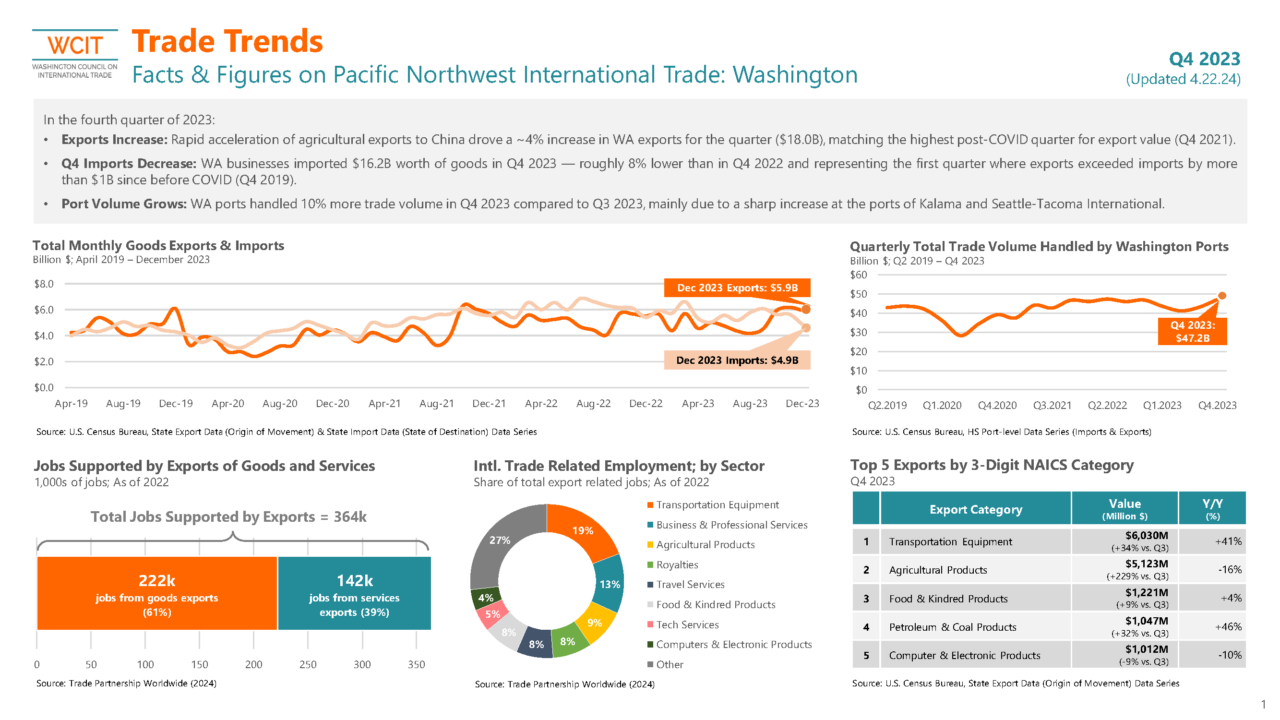
  • Washington handles ~$45B in quarterly trade volume, supporting 364,000 jobs across goods (61%) and services (39%) exports
  • After being a net importer since 2019, exports finally exceeded imports by $1B+ in Q4 2023, with transportation and agriculture leading exports
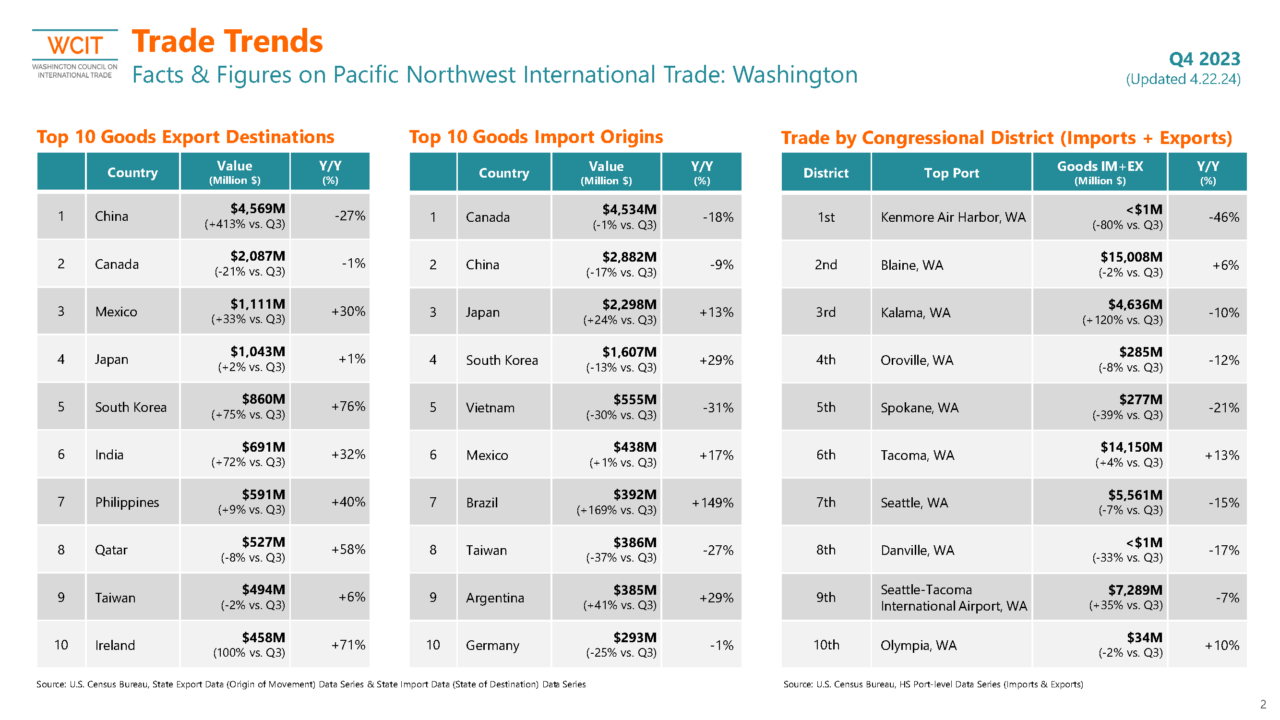
  • Key trading partners remain Canada, China, and Japan, while the ports of Blaine and Tacoma show strong performance in Pacific trade

Washington State Trade Trends: 2021-2025: A Story of Resilience and Adaptation

Background

In Q4 2021, WCIT began publishing a quarterly dashboard of key trade statistics for Washington state. The dashboard tracks metrics that showcase our region’s key role in international trade, including total exports and imports, port volumes, major trading partners for exports and imports, and employment data. Readers can find quarterly updates on Washington’s top export categories, such as transportation equipment and agricultural products, along with detailed breakdowns of trade volumes through top ports and by Congressional district. The dashboard also monitors trade volume with key partners and tracks how international trade supports local jobs, sustaining over 800,000 positions across the Northwest. These metrics tell the story of our region’s dependence on international trade and its crucial position in global commerce, offering policymakers, business leaders, and the public clear insights into the Northwest’s trading economy. Each quarter, the dashboard is updated when all new data is available, approximately 3-4 months after the period ends.

In Q3 2023, we expanded the WCIT Trade Dashboard to include Oregon and Idaho, recognizing the region’s interconnected role in trade.

What Story Does the Data Tell?

Once we have more historical data for Oregon and Idaho, our trend analysis will cover the region. For now, let’s look at the story the data tells for Washington state.

Washington state’s international trade landscape from late 2021 through mid-2024 tells a story of economic resilience amid global challenges. The data reveals how our ports, businesses, and trading relationships have evolved, showcasing both our strengths and areas of opportunity in the international marketplace.

Trade Volume and Economic Impact

Our state consistently handles around $45 billion in quarterly trade volume, though we’ve seen some fluctuation. While this slightly softens from peak levels, it demonstrates Washington’s continued significance in global trade. Notably, international trade supports 364,000 jobs across Washington, with 61% in goods exports and 39% in services exports – a testament to our diverse trade economy.

Shifting Export Patterns

Two key export categories tell an essential story about Washington’s trade dynamics. Transportation equipment, primarily driven by our aerospace sector, has remained a crucial export despite significant quarterly variations. While following traditional seasonal patterns with fourth-quarter peaks, agricultural exports have shown some decline, reflecting changing global market conditions and increased competition.

Imports Steadily Climb While Exports Catch Up

In 2019, Washington state’s imports began to exceed exports, with the gap widening in 2020. Since then, Washington state was a net importer until Q4 2023, when exports exceeded imports by more than $1B – the first quarter since pre-pandemic (Q4 2019).

Trading Partners: Evolution and Stability

Our trade relationships highlight both change and consistency. Canada, China, and Japan continue to be top trading partners. At the same time, Taiwan, South Korea, Ireland, Vietnam, and Malaysia are all examples of countries where trade volume has fluctuated significantly between quarters. This diversification of trading partners demonstrates Washington’s ability to adapt to changing global conditions while maintaining strong regional relationships.

Port Performance

Washington’s ports continue to demonstrate their crucial role in Pacific trade. The ports of Blaine and Tacoma, in particular, have shown robust performance, with Tacoma’s volumes generally increasing over the period. This success reflects our strategic location and our ports’ operational efficiency in handling international cargo.

Looking Forward

As we move through 2024, Washington’s trade sector shows signs of stabilization after the volatility of recent years. While overall trade volumes have moderated from their peaks, our consistent employment numbers and stable port operations suggest a resilient trade infrastructure ready to capitalize on new opportunities.

The data reveals the Northwest’s dynamic and adaptable trade economy. It maintains its crucial role in international commerce while adjusting to changing global conditions. This resilience positions our state well for future growth and continued leadership in international trade.

WCIT Q1 2025 Trade Dashboard

NOTE: The Q2 2025 updates are delayed due to the Federal government’s shutdown. We will update the dashboard as soon as the data is available.

This edition of the WCIT Northwest Trade Dashboard covers January – March 2025, so it does not include the immediate impacts of new tariff rates announced by the Trump Administration in early April 2025. However, elevated trade activity with major Southeast Asian trade partners in Q1 2025 may indicate efforts to pre-position inventories and trade flows ahead of the assumed tariff rates.

Monthly container volume reporting from major ports along the West Coast imply a mixed outlook for trade activity in the aftermath of tariff announcements. Although reporting suggests that Q2 2025 will show a meaningful drop in trade volume relative to Q1, the Northwest Seaport Alliance (NWSA) and other top West Coast ports have reported stable foreign trade container volumes on a year-over-year basis. For example, as of the end of June 2025, the NWSA reported a 13% and 6% decline in international import and export container volumes relative to Q1 2025, but a 3% increase in import volumes and a 3% decrease in export volumes relative to the same period in 2024 (source). Similarly, the Port of Long Beach, CA reported a 13% and 10% drop in import and export volume respectively from Q1 to Q2 2025, but a 9% increase in import volume and 3% decrease in export volume relative to the same period in 2024 (source).

In context, increased trade volume observed in Q1 2025 appears to have largely offset the quarterly decrease we expect to see in Q2 2025, and, in most cases, the overall volume of trade has been fairly consistent despite the recent policy changes. While the Q2 edition of the dashboard may show significant changes for a few of the goods and/or ports covered on the dashboard, overall, the changes to tariff rates do not appear to have fundamentally altered near-term levels of trade activity in the Northwest relative to 2024.

Below are highlights and insights from Q1 2025 for each state.

Washington

  • Exports Rise: WA exports grew 4% on a quarterly basis, buoyed by strong growth in transportation equipment exports relative to last year and especially last quarter.
  • Import Levels Increase: WA imports climbed 5% on a quarterly basis, partially due to higher import levels from Southeast Asian countries like Vietnam, Taiwan, and Thailand compared to a year ago.
  • Port Volume Expands: WA port volumes were slightly higher on a quarterly basis (+3%), mostly because of greater volume transiting two major ports — Blaine and Sea-Tac Int’l Airport.

Oregon

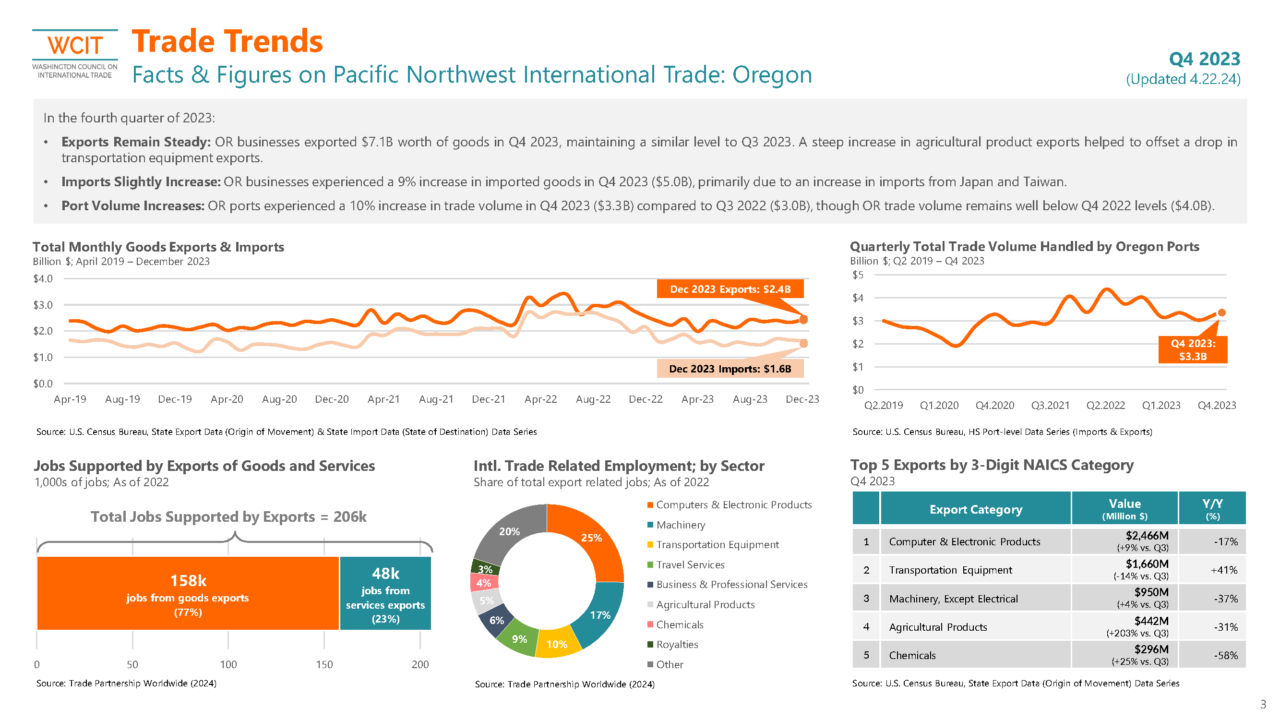
  • Exports Fall: OR exports dropped 10% on a quarterly basis, partially because of a large decrease of machinery exports compared to Q4 2024.
  • Imports Slip: OR imports contracted slightly on a quarterly basis (-4%), in part due to a significant reduction in imports from Taiwan compared to the previous quarter.
  • Port Volume Shrinks: OR port volumes sank 9% on a quarterly basis; trade volume at the Port of Portland was moderately down compared to a year ago.

Idaho

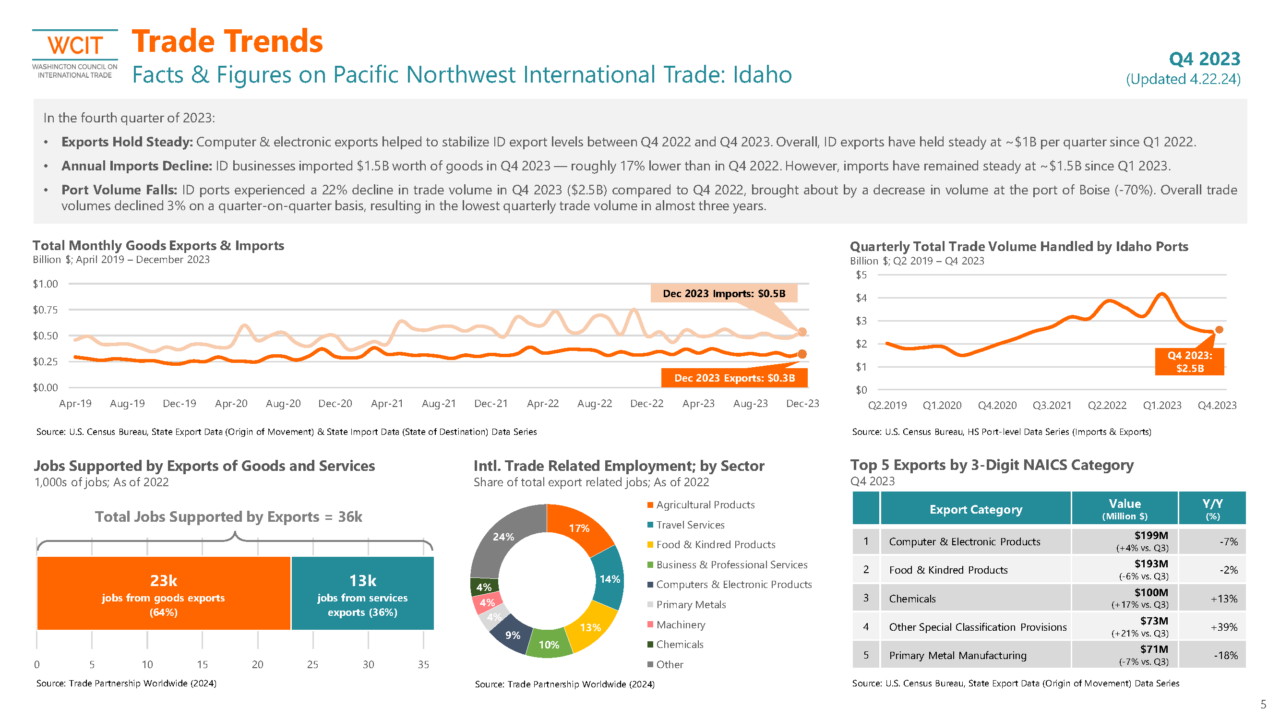
  • Exports Rise: ID exports expanded 14% on a quarterly basis, largely due to a significant increase in primary metal manufacturing exports.
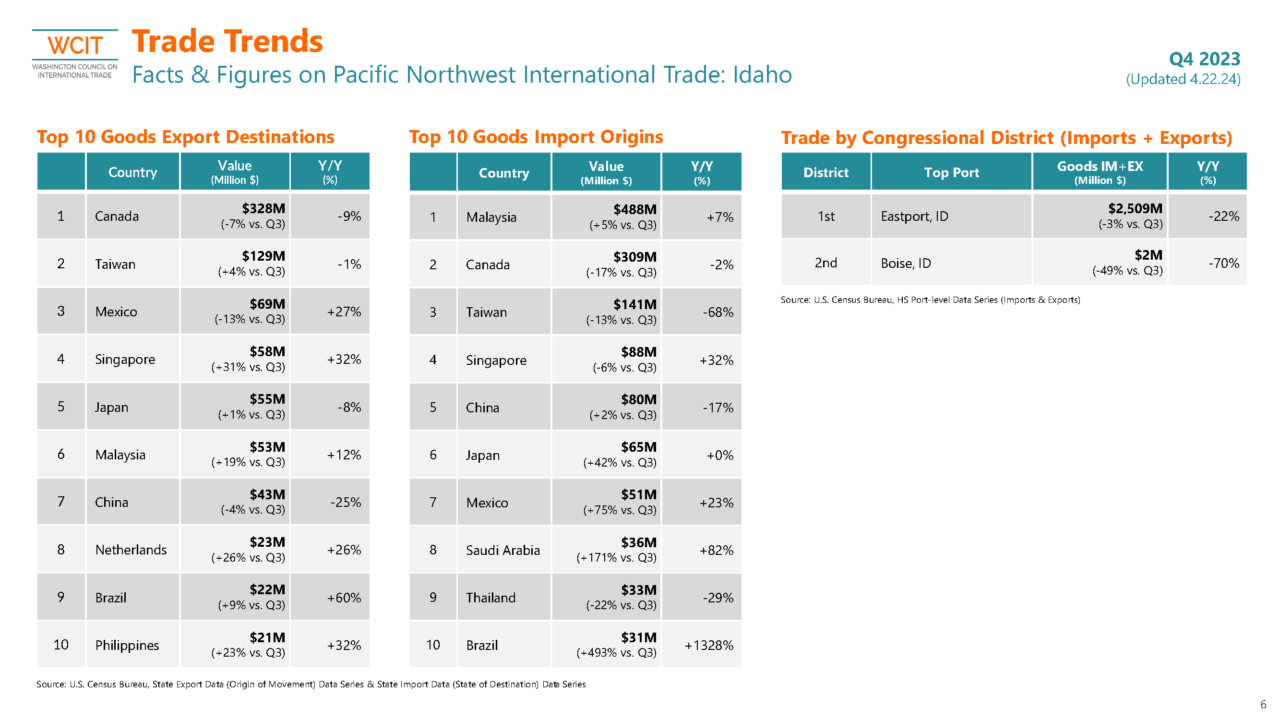
  • Import Levels Fall: ID imports decreased 7% on a quarterly basis, partially as a result of a drop in imports from both Malaysia and Singapore this quarter.
  • Port Volume Jump: ID port volumes shot up 36% on a quarterly basis, almost completely due to a sharp jump in volume at the port of Eastport compared to Q4 2024.

Current and Previous Dashboards