The Future of Trade: Positioning Washington State for Economic Growth in the Next Decade
1Executive Summary
Favorable geography, a diverse economy, and an expansive public port system have enabled Washington state's economy to reap the benefits of international trade — helping the state's businesses and farmers to thrive in the global marketplace. Trade supports roughly one in five jobs in Washington. Exports of Washington-made goods and services directly support nearly a quarter of a million jobs across a diverse range of economic sectors including agricultural products, manufacturing, and professional services.
However, over the past five years, three main factors have hampered international trade growth in Washington: (1) U.S. trade tensions with China; (2) a retreat from globalization resulting in protectionist trade policy; and (3) disruptions stemming from the COVID-19 pandemic.
Washington state can overcome these challenges by pursuing smart public policies centered on three foundational pillars: (1) leverage the state's strengths; (2) address current trade challenges and explore new market opportunities; and (3) position our economy to turn new challenges into opportunities. Fortunately, the state has the tools and natural advantages to be the epicenter of a West Coast innovation economy.
2Trade Drives Washington's Economy
Trade is a critical engine of economic growth and job creation in Washington state. The state's geographic advantages, diversified economy, and extensive port system have created an environment where businesses of all shapes and sizes can thrive. Roughly one in five jobs in the state are supported by trade with other states and nations — approximately 900,000 total jobs.1
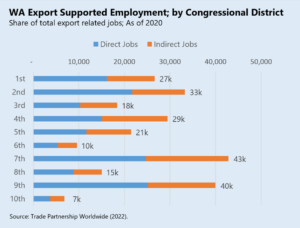
Export-supported employment reaches every Congressional district across Washington state, from the Pacific Coast to the Idaho border.
Washington has an extensive public port system stretching across the entire state — 75 port districts across 33 of Washington's 39 counties.2 This infrastructure ensures the benefits of trade are shared throughout every Congressional district and provides essential access to international markets for all 12,000 exporting businesses in the state — 89% of which are small and medium businesses.3,4 These organizations range from cherry and apple orchards in the Yakima Valley to fishermen in the Columbia Basin to advanced manufacturing companies in the Puget Sound region.
Export-Supported Jobs by Sector
In 2020, exports of Washington-made goods and services directly supported nearly 246,000 jobs across a diverse range of economic sectors:5
- Business & Professional Services — 37,000 jobs supported by exports
- Agricultural Products — 32,000 jobs supported by exports
- Transportation Equipment — ~30,000 jobs supported by exports
- Higher Wages — Export-dependent employers in Washington paid employees ~16% higher wages compared to less export-intensive businesses6
Washington's Technology Sector: A Trade Powerhouse
The state's technology sector plays a prominent role in Washington's trade-based economy, employing more than 280,000 people and making the state an attractive destination for foreign-owned companies and investment.7,8 Employment in the Seattle region's tech sector increased more than 35% from 2016 to 2020 — more than any other region in the country.9
Washington businesses exported more than $23 billion of digitally tradeable information and communications technology (ICT) services in 2020. By delivering high-demand digital exports to a worldwide customer base without traditional trade infrastructure, the sector proved highly resilient during COVID-19: digital exports decreased a mere 6% in 2020, a stark contrast to goods and services exports, which declined by more than 30% over the same timeframe.10,11
Despite the sharp decrease in international goods and services trade during the pandemic, exports rebounded strongly: goods exports in 2021 were 30% higher than in 2020, with Q4 2021 exports higher than any quarter since 2018.12
3U.S.–China Trade Tensions
In the early 2010s, trade with China was a key driver of export growth as Washington's port system made the state a gateway to the Chinese economy for U.S. businesses. However, deteriorating U.S.-China trade relations have negatively impacted Washington exporters. Although China remains an important destination for Washington exports, the relationship has become more complex given economic competitiveness, security, and strategic concerns.
Major U.S.-China trade disputes from 2017 to 2019 — including the imposition of tariffs in both directions — caused a steep decrease in Washington exports to China.13 Companies ceded global market share in key sectors including transportation equipment and agricultural products — Washington's top two export sectors by trade value.14
Cascading Losses Across Washington Agriculture
From September 2018 to August 2019, the toll on Washington's agriculture sector was severe: wheat exports to China declined by 94%, dairy exports declined by 75%, and fruit exports declined by 16%.16 By 2019, many Washington farmers were reliant on federally funded bailouts to remain in business.17 Even with a Phase One Agreement signed in 2020 — under which China committed to purchasing an additional $200B of U.S. exports — China's purchases only fulfilled 57% of the total commitment, and trade between Washington and China has not yet returned to pre-trade war levels.18
4Shift to Tariff-First Trade Policy
Since 2017, the federal government's approach to trade has created an environment of confusion and unpredictability, with tariffs used as a tool of first resort — upending years of relatively consistent trade policy. This shift was apparent early in the Trump Administration with the U.S. withdrawal from the Trans-Pacific Partnership (TPP) in 2017 — a comprehensive free trade agreement that included most countries with a trade presence in the Pacific Ocean, including many of Washington's top export destinations.
TPP Withdrawal: $67M Annual Loss for Washington Agriculture
Under the TPP, Washington's agricultural exporters were projected to generate an additional $67M in annual cash receipts compared to the baseline.20 The withdrawal denied Washington farmers those market gains while competitors in other TPP member countries benefited from the agreement's tariff reductions.
Despite the Biden Administration's efforts to reset America's relationship with the world, it has not removed — and even reinstated — many of the tariffs on Chinese goods put in place by the prior administration.21 There has also been little forward progress to renegotiate, expand, or pursue new Free Trade Agreements (FTAs) such as a post-Brexit FTA with the U.K.
The importance of expanding and establishing new FTAs cannot be understated: on a per capita basis, U.S. FTA partners purchase approximately 8× more exports from Washington state than non-FTA countries.23 As a concrete example, Washington's exports to Morocco increased by almost 600% since signing an FTA with that country in 2006. Additionally, establishing trade agreements that reflect the realities of an increasingly digital economy can foster a mutually beneficial environment by providing much-needed regulatory certainty to Washington's tech sector.24
The Russian invasion of Ukraine has added another layer of uncertainty. Western sanctions have cut off most trade between the U.S. and Russia, and the invasion has hastened a new period of geopolitical uncertainty that may impact trade relationships with other economies bordering the Pacific.
5COVID-19 Impacts on Washington Trade
The COVID-19 pandemic had a significant impact on Washington's trade-driven economy.25 Although Washington fared better than many states, employment remains below pre-pandemic levels.26 The state's port system bore the brunt of logistical issues resulting from the rapid stop-and-start of the global economy.
Canadian Port Competition: A Structural Threat
While the acute short-term pressures caused by an unprecedented backlog of containers have eased, Canadian government investment to modernize and improve port infrastructure and increase capacity has shifted the competitive balance in favor of nearby ports in British Columbia — resulting in reduced volume and potential revenue for Washington state ports.27 This infrastructure gap underscores the urgency of deploying federal funding from the Infrastructure Investment and Jobs Act to Washington's port system.
On the positive side, the pandemic demonstrated the resilience of Washington's digital economy. While goods and services exports fell more than 30% in 2020, the state's digital ICT service exports decreased by only 6% — underscoring the value of digital trade agreements and the state's tech-sector competitive advantage.
6Emerging Opportunities
Despite a challenging five years, Washington's economy stands to benefit from recent legislative developments that can facilitate trade by making the state's infrastructure more efficient and reliable.
Infrastructure Investment and Jobs Act
The recently enacted Infrastructure Investment and Jobs Act gives Washington's ports access to a total nationwide pool of $5 billion in funding for port-specific projects and $27 billion for trade-related infrastructure improvements.28 This funding offers the promise to support widespread improvement of the state's extensive trade infrastructure — including important rail and highway links — and bolster Washington's role as a trade hub for states across the Northwest and Upper Midwest.
Federal investment in port infrastructure should also increase the competitiveness of Washington's ports compared to nearby Canadian locations. Combined with focused policymaking that shifts national priorities from tariffs and managed trade back to global free trade, recent developments could help the state's businesses begin a new decade of consistent trade growth.
The Green Economy & Digital Trade
Major trends are shaping the future of the global economy. Washington state has been at the cutting edge of technology from the emergence of the aerospace industry to the advent of the internet. To remain a global tech hub, the environment for innovation, exploration, investment, and discovery must be maintained through constructive public-private partnerships.
The transition to a "green" economy also presents new opportunities for Washington businesses. Policymakers should closely monitor the impact that a patchwork of laws and regulations from different countries may have on global trade — including understanding the potential impact of carbon border adjustment measures — and support innovations that will make global trade more efficient and sustainable.
7Three-Pillar Policy Framework
To reap the full benefits of international trade, federal and state policymakers and private sector stakeholders should actively support strategies focused around three core pillars:
Pillar 1: Leverage Washington's Strengths
Washington's geographical advantages, supporting infrastructure, and diverse economy are well suited for trade growth. Increased infrastructure funding from the Infrastructure Investment and Jobs Act should be strategically deployed to improve and expand the state's ports and freight mobility. The state's diverse economy sits at the nexus of both West Coast innovation and an expansive agricultural network spanning the North and Upper Midwest U.S. Washington's elected officials and community and business leaders must continue to recognize the important link between trade and economic growth and pursue policies that reflect it.
Pillar 2: Address Challenges & Explore New Markets
Policies that undermine the free flow of goods and services disproportionately hurt Washington's trade-intensive economy. Elected officials and community leaders must be active in opposing policies that undermine international trade and vocal in advocacy efforts to:
- Normalize strained trade relationships, particularly with China
- Clear tariff and non-tariff barriers to trade
- Establish new and updated Free Trade Agreements to expand market share and access for Washington businesses
- Restore the competitive edge of Washington's port system and agricultural sector
- Ensure federal funding from the Infrastructure Investment and Jobs Act is directed to improve trade infrastructure
Pillar 3: Position for Future Opportunities
Washington state has been at the cutting edge of technology and must remain so to capitalize on the tech-driven transformation of the global economy. The same innovative approach can help Washington manage the transition to a green economy, where alternative energy sources and new technologies will present new opportunities for businesses throughout the region.
8Agriculture Export Spotlight
Washington's agriculture sector remains a globally prominent export powerhouse. The following data from 2021 illustrates the breadth of the state's agricultural trade relationships.
| Rank | Top Export Products (2021) | Value | Top Customer Markets (2021) | Value |
|---|---|---|---|---|
| 1 | Soybeans | $8,125M | China | $9,575M |
| 2 | Corn | $3,850M | Japan | $2,206M |
| 3 | Wheat & Meslin | $2,532M | South Korea | $1,160M |
| 4 | Prepared Potatoes | $847M | Philippines | $804M |
| 5 | Apples | $643M | Canada | $566M |
| 6 | Forage Products | $601M | Taiwan | $535M |
| 7 | Cherries | $267M | Mexico | $243M |
| 8 | Hops | $242M | Thailand | $190M |
| 9 | Sorghum | $233M | Vietnam | $128M |
| 10 | Fresh Potatoes | $90M | Netherlands | $70M |
Source: U.S. Census Bureau (2022). Exports by State of Origin.
Did You Know? Washington State Facts
- Washington is the #1 U.S. producer of apples, sweet cherries, blueberries, hops, pears, and spearmint oil
- Washington operates the largest public port system in the world, with 75 port districts
- Washington is situated roughly an equal distance from Asian and European markets
- Washington increased exports to Morocco by almost 600% since signing an FTA with the country in 2006
- Washington has the largest share of technology-related services exports in the U.S.
- Washington technology sector wages grew 15% over the past five years — second only to Silicon Valley
- Washington's space industry startups generated $4.6B of GDP and $1.6B of labor income in 2021
Conclusion
The challenges of the past five years have upended decades of steady trade growth for Washington businesses. Although the state's technology sector has proven incredibly resilient, the twin headwinds of protectionist trade policies and a massive, pandemic-induced shutdown of the global economy have created a difficult environment for export-oriented businesses in Washington.
Through smart and effective advocacy, stakeholders can help direct the funding and investments needed to bolster Washington's trade infrastructure and establish new and updated market relationships that can increase trade flows with both new and existing partners. With the right environment, Washington has the cutting-edge economy, beneficial geography, and world-class talent to capitalize on the new opportunities created by the rapidly changing 21st century economy.
Leveraging the state's advantages to solidify Washington as the epicenter of a West Coast innovation economy can accelerate growth, create jobs, and improve the well-being of all Washingtonians in the coming decade.
Endnotes
- Business Roundtable (2022). How Washington's Economy Benefits from Trade & Investment. brt.org
- Washington Public Ports Association (n.d.). Frequently Asked Questions. washingtonports.org
- Data provided by The Trade Partnership Worldwide.
- Business Roundtable (2022). How Washington's Economy Benefits from Trade & Investment.
- Washington State Department of Commerce (n.d.). Our Key Sectors: ICT. choosewashingtonstate.com
- Business Roundtable (2022). How Washington's Economy Benefits from Trade & Investment.
- Bishop, T. (2021). "Seattle leads nation in 'brain gain.'" GeekWire. geekwire.com
- United States Chamber of Commerce (2022). The Digital Trade Revolution. uschamber.com
- United States Census Bureau (2022). Exports by State of Origin. usatrade.census.gov
- United States Census Bureau (2022). Exports by State of Origin.
- USDA Foreign Agricultural Service (2020). China: Evolving Demand in the World's Largest Agricultural Import Market. fas.usda.gov
- Seattle Times staff (2019). "Washington farmers, hurt by tariffs, are helped by federal bailout." seattletimes.com
- Seattle Times staff (2019). Ibid.
- Brown, C. (2022). "China bought none of the extra $200 billion of US exports in Trump's trade deal." Peterson Institute for International Economics. piie.com
- United States Census Bureau (2022). Exports by State of Origin.
- National Association of State Departments of Agriculture (2016). Agriculture Needs TPP.
- Reuters staff (2022). "U.S. reinstates 352 product exclusions from China tariffs." reuters.com
- Bown, C., Russ, K. (2021). "Biden and Europe remove Trump's steel and aluminum tariffs." Peterson Institute for International Economics. piie.com
- Business Roundtable (2022). How Washington's Economy Benefits from Trade & Investment.
- Cory, N. (2022). "U.S. Options to Engage on Digital Trade and Economic Issues in the Asia-Pacific." ITIF. itif.org
- United States Chamber of Commerce (2022). The Digital Trade Revolution.
- Ettlinger, M., Hensley, J. (2021). "COVID-19 Economic Crisis: By State." UNH Carsey School of Public Policy. carsey.unh.edu
- Anderson, D., Davies, P., Hanh, L. (2022). "Canadian and U.S. port infrastructure funding and policy." Association of Pacific Ports. pacificports.org
- American Association of Port Authorities (2021). Federal Funding for Ports. aapa-ports.org
- Garcia, A. (2018). "Is a state with no income tax — like Washington — better or worse?" Seattle Times. seattletimes.com